

Piano Odyseja
A Journey Through Piano, Sound and Space
Piano Odyseja is a piano project by composer and pianist Atanas Valkov, unfolding across 22 pieces and nearly two hours of music. Developed through improvisation, studio experimentation and live performances, the album explores the piano as a space of evolving sound and musical transformation. Moving between contemporary classical language, improvisational textures and sonoristic explorations of the instrument, the work reveals the piano as both a structural and expressive medium.
In selected moments, elements derived from scientific recordings from international space missions enter the musical process through real-time sonification and timbre transfer, becoming part of a responsive sonic environment shaped by the performer’s gesture.
PIANO, DATA and Algorithm
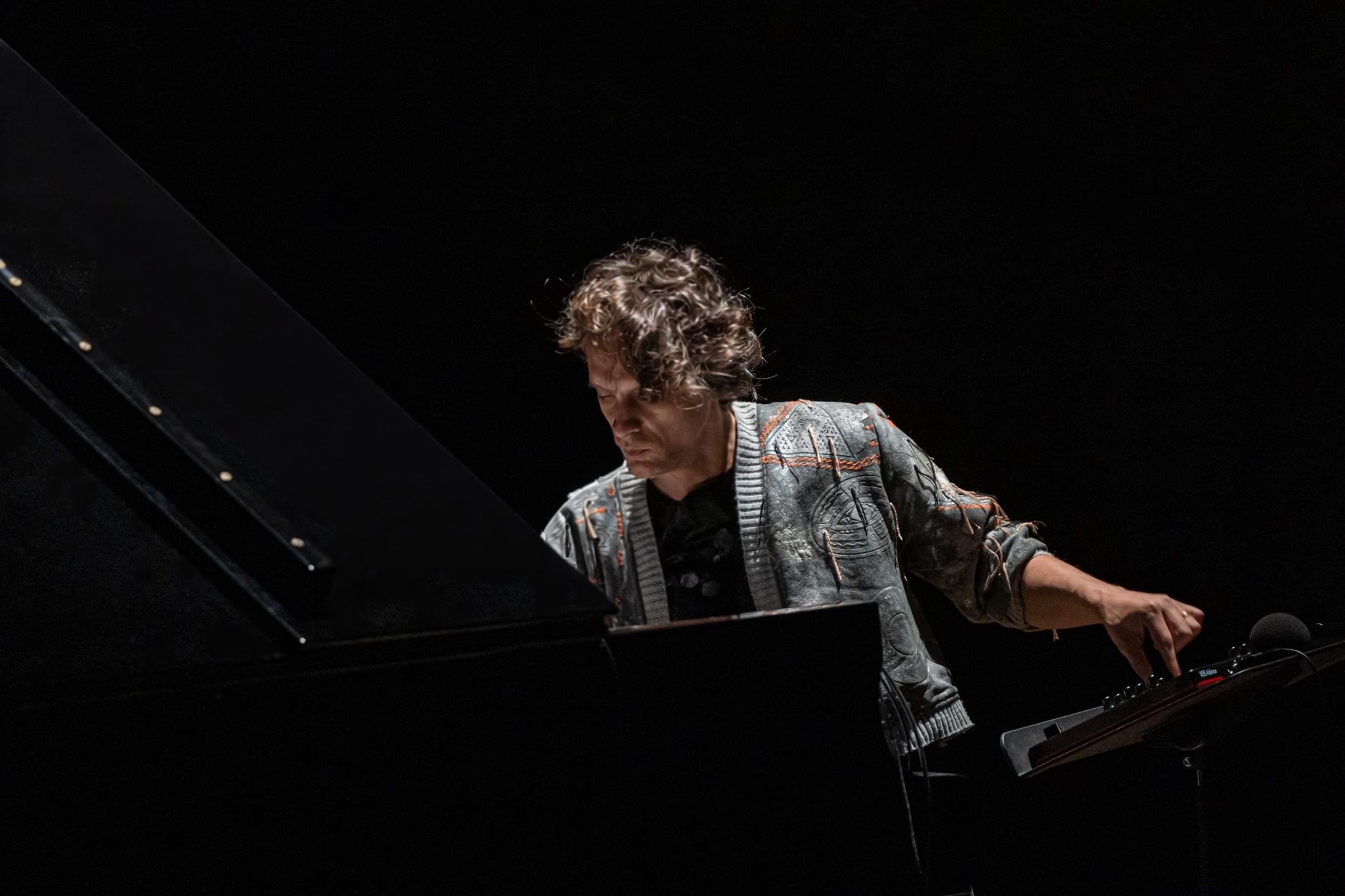
In Piano Odyseja, improvisation becomes the central compositional method. Through both controlled and spontaneous improvisation, Atanas Valkov develops what he describes as a “sound continuum” — a musical structure evolving in real time at the piano. The album moves between contemporary classical language, thematic variations and dense improvisational textures, including sonoristic explorations and prepared piano techniques. In selected moments the acoustic gesture of the piano enters a dialogue with technology, where real-time processes respond directly to the performer’s touch. Improvisation becomes a meeting point between instrument, algorithm and chance.
Space Signals as Musical Material
In Piano Odyseja, elements derived from scientific recordings from international space missions become part of the sonic palette. Rather than functioning as sound effects, these signals act as raw sonic material. Measurements from instruments studying plasma waves and spacecraft vibrations are translated through sonification into structures that interact with the piano and shape the texture of the music.
The recordings used in the album originate from instruments deployed on international space missions, including measurements of plasma waves, electromagnetic fields and spacecraft vibration tests. Through sonification, these physical measurements are translated into audible frequencies and rhythms. In Piano Odyseja, they function as raw waveform material integrated into the musical process.

Real-Time Sonification
A key technological layer of Piano Odyseja involves real-time sonification and timbre transfer processes developed within Valkov’s performance system. The piano acts as the central controller. Parameters such as pitch, dynamics and articulation influence how external waveform data is transformed in real time. Instead of playing recordings directly, the system reshapes their spectral characteristics so they respond to the pianist’s gestures, allowing scientific signals to become part of an evolving sonic environment.
The Recording Journey of Piano Odyseja
Piano Odyseja developed gradually between Valkov’s composer studio and a series of live performances.
The project began with experiments combining piano improvisation and sonification technologies in the studio environment. As the musical language evolved, selected performances were presented during special pre-release concerts, where many of the improvisations that form the album were recorded live.
These sessions took place in venues including S1 Studio of the Polish Radio Concert Hall, Nowa Miodowa, Galeria Labirynt and LAS Studio, each shaping the sound of the recordings.
LEGENDARY Polish Radio S1 Studio
At Polish Radio S1 Studio in Warsaw, designed with meticulous care to achieve acoustic perfection, the music resonated with precision and clarity. The studio, opened in 1991 and named after Witold Lutosławski, is renowned for its natural acoustics and has become a landmark for musical excellence in Europe.
NOWA MIODOWA CONCERT HALL
In Nowa Miodowa Concert Hall, designed by Tomasz Konior and acoustically perfected by Yasuhisa Toyota of Nagata Acoustics, the music took on warmth and intimacy. The hall’s natural wood interiors and flawless design created an environment where every sound felt alive, connecting artist and listener in an almost private exchange.
Atanas Valkov describes Piano Odyseja as a reflection on endless exploration—mysterious yet structured. It is music as discovery—a bridge between tradition and innovation; emotion and intellect; Earth and cosmos.
This project is not about perfection but discovery. It invites listeners to embark on their own journey through soundscapes shaped by improvisation, cosmic inspiration, prepared techniques, and cutting-edge technology.
Scientific recordings used in Piano Odyseja originate from instruments and research teams involved in several international space missions, including
BepiColombo,
PLATO, Cluster,
JUICE, Cassini–Huygens
Rosetta / Philae.
The project was made possible thanks to the generosity of scientists and mission teams who share their data and recordings with the wider scientific and artistic community.
Scientific Audio Credits
Flybys at Earth and Mercury
Sonified accelerometer data from the ISA instrument on the ESA/JAXA BepiColombo mission
Credit: ESA, JAXA, BepiColombo, ASI, INAF/IAPS, Carmelo Magnafico / ISA team
PLATO Spacecraft Sine Vibration Test
Audio from PLATO spacecraft sine vibration test at ESA’s ESTEC
Courtesy: ESA PLATO project team, Thomas Walloschek & Mike Healy
Dawn in Space / Atmospheric Whistler / Auroral “Star Wars”
Sonified plasma wave data from the WBD instrument on the ESA Cluster mission
Courtesy: ESA, NASA & The University of Iowa
Licensed under CC BY 4.0 INT — https://space-audio.org
Earth’s Magnetic Song (Calm Space Weather Conditions)
Sonified plasma data from the FGM instrument on the ESA Cluster mission
Credit: Data from L. Turc et al. (2019, GRL)
Audio courtesy: Martin Archer (Imperial College London)
Flyby at Earth
Sonified plasma wave data from the RPWI instrument on the ESA JUICE mission
Credit: ESA, JUICE, Philippe Zarka, LIRA, Observatoire de Paris – PSL – CNRS, Meudon, France
Passage Through Saturn’s Rings
Sonified plasma wave data from the RPWI instrument on the NASA/ESA/ASI Cassini–Huygens mission
Courtesy: NASA & The University of Iowa
Licensed under CC BY 4.0 INT — https://space-audio.org
Sound of Touchdown on Comet 67P/Churyumov–Gerasimenko
Sonified accelerometer data from the SESAME/CASSE instrument on the ESA/DLR/MPS/CNES/ASI Philae probe
Credit: ESA, Rosetta, Philae; W. Arnold et al. (2025, Acta Astronautica), CC BY
Audio Sources Coordination
Mark McCaughrean


