


Piano Odyseja

A Journey Through Sound, Space & the Infinite Piano

Welcome to the world of Piano Odyseja, a new project by distinguished composer and pianist Atanas Valkov. Known for his original and innovative approach to film music and storytelling, Valkov’s latest work takes listeners on an extraordinary journey where experimental piano compositions merge with the vast mysteries of space and technology. By combining authentic sounds from the European Space Agency (ESA), real-time AI sonifications, and cutting-edge timbre transfer technology, Piano Odyseja redefines the boundaries of music, science, and art.

Featuring original sounds from
A Conversation Between Artist, AI and Universe


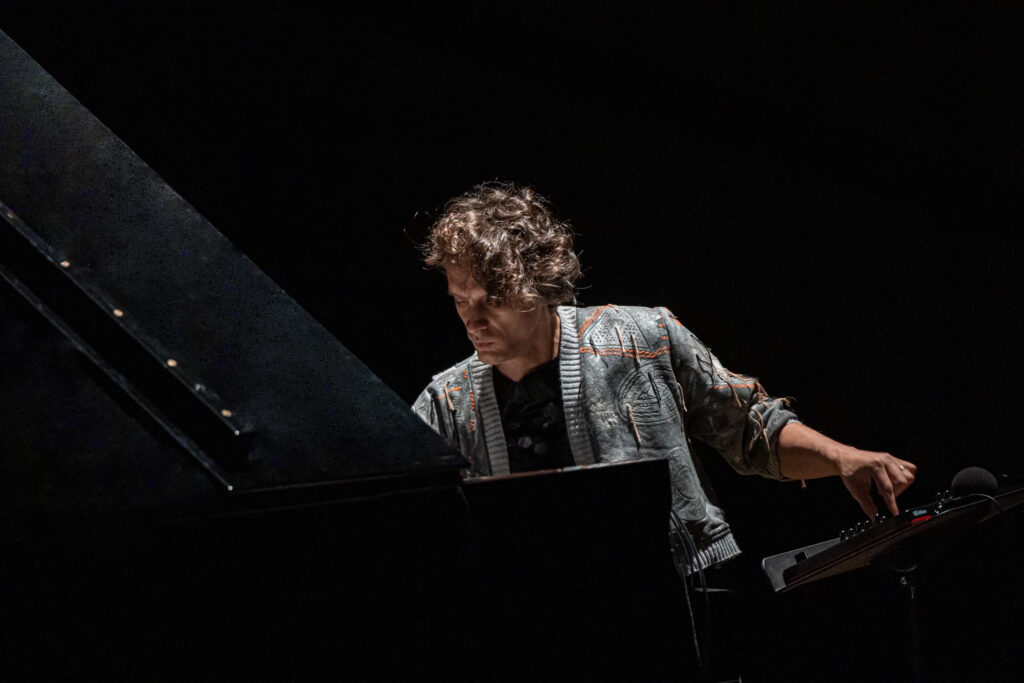
Through both controlled and free improvisation, Valkov creates in real-time, what he calls a “sound continuum,” blending aleatoric and prepared techniques with harmonic and rhythmic looped structures without any live synth or sample playback. 

This live approach allows him to explore the unpredictable beauty of chance while maintaining a deep connection to classical and contemporary traditions. Improvisation becomes a dialogue—between artist, AI, and instrument, between structure and freedom, between the known and the unknown. 


ESA Space Sounds: Hearing the Universe

In Piano Odyseja, Atanas Valkov takes listeners on a journey beyond the boundaries of Earth by weaving authentic sounds from the European Space Agency (ESA) directly into his music. This isn’t Valkov’s first encounter with the mysteries of space—he previously collaborated with ESA on the soundtrack for the Ambition, which depicted the historic Rosetta mission and the landing on a comet.
 

For this project, Valkov delves even deeper, using advanced sonification techniques to transform raw cosmic data—gravitational waves, planetary orbits, and other celestial phenomena—into evocative musical elements. These are not just background effects; the space sounds become an essential part of the sonic landscape, echoing the vastness, rhythm, and enigma of the universe itself. Valkov also explores the hidden musicality of machines and spacecraft, reshaping the hum of engines, the pulse of telemetry, and the subtle noises of cosmic instruments into rich, cinematic textures reminiscent of atmospheric pads and soundscapes. Through this creative process, mechanical sounds are elevated into expressive, filmic layers that blur the line between science and art. By collaborating with ESA and integrating these unique sounds, Valkov invites listeners to experience the cosmos in an entirely new way—where the language of space becomes music, and the wonders of the universe are felt as much as they are heard.


Real-Time AI Sonification & Timbre Transfer

In Piano Odyseja, the piano functions as a real-time controller, dynamically triggering advanced, AI-driven sound transformations. Leveraging state-of-the-art sonification and timbre transfer algorithms, the system is enhanced by Valkov’s custom-designed live sound processing workflow. This setup continuously analyzes the pitch, dynamics, and articulation of Valkov’s performance in real time. The AI models map these musical parameters to generate harmonically and spectrally aligned textures, utilizing both synthesized and processed ESA space sounds. Through real-time pitch tracking and spectral morphing, the AI is able to re-synthesize and blend external audio sources—such as raw cosmic data and machine recordings—so they interact musically with Valkov’s piano phrasing. The result is a non-deterministic, emergent soundscape: new timbral structures and sonic layers are created on the fly, with a high degree of unpredictability and musicality. 


The Recording Journey of Piano Odyseja

Piano Odyseja was born in Atanas Valkov’s composer studio—a creative space where award-winning soundtracks have taken shape and where the first experiments with AI technology began. Here, surrounded by nature, Atanas blended piano improvisation with cutting-edge sonification, laying the foundation for the album’s unique sound. As the project evolved, select closed-door concerts were organized, capturing live recordings that now form the heart of the album. Each venue—from the solitude of the studio to Poland’s most iconic concert halls—helped shape not just the sound, but the spirit of Piano Odyseja, making every track a true reflection of this musical and technological journey.


LEGENDARY Polish Radio S1 Studio

At Polish Radio S1 Studio in Warsaw, designed with meticulous care to achieve acoustic perfection, the music resonated with precision and clarity. The studio, opened in 1991 and named after Witold Lutosławski, is renowned for its natural acoustics and has become a landmark for musical excellence in Europe.


NOWA MIODOWA CONCERT HALL

In Nowa Miodowa Concert Hall, designed by Tomasz Konior and acoustically perfected by Yasuhisa Toyota of Nagata Acoustics, the music took on warmth and intimacy. The hall’s natural wood interiors and flawless design created an environment where every sound felt alive, connecting artist and listener in an almost private exchange.


Atanas Valkov describes Piano Odyseja as a reflection on endless exploration—mysterious yet structured. It is music as discovery—a bridge between tradition and innovation; emotion and intellect; Earth and cosmos.

This project is not about perfection but discovery. It invites listeners to embark on their own journey through soundscapes shaped by improvisation, cosmic inspiration, prepared techniques, and cutting-edge technology.


This project would not have been possible without the generous support of the European Space Agency (ESA), whose authentic space sounds and collaboration have been integral to Piano Odyseja.